Shutter
speed along with the aperture of the lens (also called f-number)
determines the amount of light that reaches the film or sensor. Conventionally,
the exposure is measured in units of exposure value (EV),
sometimes called stops, representing a halving or doubling of the exposure.
Multiple
combinations of shutter speed and aperture can give the same exposure: halving
the shutter speed doubles the exposure (1 EV more), while doubling the aperture
size (halving the focal number) increases the exposure area by a factor of 4 (2
EV). For this reason, standard apertures differ by √2, or about 1.4. Thus an
exposure with a shutter speed of 1/250 s and f/8 is the same as with 1/500 s
and f/5.6, or 1/125 s and f/11.
In
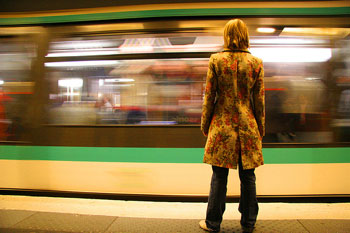
addition to its effect on exposure, the shutter speed changes the way movement
appears in the picture. Very short shutter speeds can be used to freeze
fast-moving subjects, for example at sporting events. Very long shutter speeds
are used to intentionally blur a moving subject for artistic effect. Short
exposure times are sometimes called "fast", and long exposure times
"slow".
Adjustment
to the aperture controls the depth of field,
the distance range over which objects are acceptably sharp; such adjustments
need to be compensated by changes in the shutter speed.
In
early days of photography, available shutter speeds were not standardized,
though a typical sequence might have been 1/10 s, 1/25 s, 1/50 s, 1/100 s,
1/200 s and 1/500 s. Following the adoption of a standardized way of
representing aperture so that each major step exactly doubled or
halved the amount of light entering the camera (f/2.8, f/4, f/5.6, f/8, f/11, f/16,
etc.), a standardized 2:1 scale was adopted for shutter speed so that opening
one aperture stop and reducing the shutter speed by one step resulted in the
identical exposure. The agreed standards for shutter speeds are:
1/1000
s
1/500
s
1/250
s
1/125
s
1/60
s
1/30
s
1/15
s
1/8
s
1/4
s
1/2
s
1 s

No comments:
Post a Comment